The FBI, Eliot Ness & "The Untouchables"
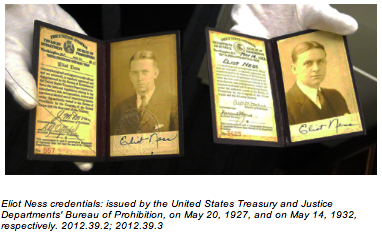
Ness identity items now preserved by the new Law Enforcement Museum
Since the 1950s TV program, Oscar Fraley's book, and with the help from the misinformed over the years, (including the media) there were millions of Americans who believed that Ness and his group were agents of the FBI. In fact, you'll find that many still do.
Regardless, it's not what Ness' association/employment was with the FBI; simply put, there really wasn't any as we'll see. Perhaps more importantly is the story of Ness and "The Untouchables" and their rightful place in law enforcement history.
And this is where an unfortunate fog rolls in...
The story of Eliot Ness and "The Untouchables" may be seen by some as an effort to find America a hero during the Cold War years of the 1950s. It wasn't disastrous in the beginning because everyone loved to see good defeat evil.
The other part of the story, however, showed itself later with a money angle that looks all too familiar. We have several to thank for that, and maybe even Ness himself.
While the historical accuracy, both written and televised, of Ness and "The Untouchables" is questionable, they are most deserved of a place in law enforcement history, especially during a time when police and governmental corruption were out of control. In the last many years, the city of Cleveland, Ohio (where he served as Public Safety Director) has honored him for his contributions to that city. His ashes, along with those of his wife and adopted son were spread over a small water body there.
But tracing back many decades, his association with J. Edgar Hoover and the Bureau Of Investigation (later changed to the FBI) was short lived and is best explained by the current FBI Historian, Dr. John Fox:
"Elliot Ness entered the picture in August 1926, when he was appointed a prohibition agent in the Treasury Department. He handpicked a small band of agents who later became known as the “Untouchables” because of their reputation for integrity. It’s said that some of Ness’ agents actually threw back the bribes offered by Capone’s men."
"In 1929, to stem the ongoing tide of corruption, the Treasury’s Bureau of Prohibition was transferred to the Department of Justice yet stayed separate from Hoover’s Bureau of Investigation. On June 10, 1933, President Roosevelt ordered the creation of a “Division of Investigation” that could consolidate both “Bureaus” inside Justice. Hoover argued against the merger, fearing that combining his 340 carefully picked agents with 1,200 prohibition agents would undercut his hard fought reforms over the previous decade. He suggested keeping the Bureau of Prohibition a separate, parallel entity."
"Hoover’s argument prevailed, and the arrangement began on July 1, 1930, with Hoover in charge of both agencies. In December 1933, the 21st amendment repealed prohibition for good, and the Bureau of Prohibition was eventually disbanded. Ness had worked under Hoover just over a month—from July 1 until August 10, 1933, when he was named a senior prohibition investigator in Cincinnati. " (source ~ FBI website at fbi.gov)
While Ness did submit an application to the FBI for Agent employment, it was turned down in part due to salary differences and probably more importantly, his close relations with the press. (Ness' brother in law, Alexander Jaime, was an FBI agent and this may have added to some confusion.)
The existing evidence in FBI files clearly reveals Ness was cooperative with local FBI Field Offices whenever in contact with them. There was, however, the flamboyant side of Ness and his relations with the press that many in command positions in the '30s didn't like. It's very clear today that in many instances, Ness had a habit of notifying the press prior to a raid in order that the cameras would be there for the action. It backfired more than once.
““Fraley and Ness..the motive was clearly monetary.””
The 1957 publication of the book, "The Untouchables" by Oscar Fraley and Eliot Ness was the "original" effort to place Ness and "The Untouchables" into history and give America a new hero. But we now know that there was more going on behind the scenes with the two of them than ever let on. The motive was clearly monetary in nature and if readers came to the book looking for some historical accuracy, they probably came to the wrong place. Ness died before the book went to print so he never saw any money of sorts he had hoped for with the exception of about one thousand dollars paid up front by the publisher.
Hollywood smelled money too. And while there were allusions in the Fraley book to Ness being affiliated with the FBI, it was Hollywood and their TV program, "The Untouchables" who really cashed in on the non-existent relationship. They left viewers with lasting impressions they'd find totally wrong decades later. In their usual style, under the cloak of taking artistic liberties, they had Ness and his men intertwined in FBI investigations where the record is very clear they never participated nor had any jurisdiction. Utilizing radio personality, Walter Winchell, it all seemed authentic.
The program confused viewers about Ness and the FBI for decades and the many letters from US citizens, observed in FBI files, substantiate the confusion. J. Edgar Hoover and the Bureau in general were in constant written and oral contact with Desilu Productions about the inaccuracies of the program. Desilu obviously had no interest in checking with the FBI prior to filming. (The Bureau's efforts in this regard are seen in files available.) The FBI efforts fell on deaf ears and Desilu, owned and operated by Desi Arnaz and Lucille Ball, did what they wanted. As a result, viewers ended up walking away from their TV's believing the purposely fictitious, and actually reckless, efforts of Hollywood.
The same thing, I might add, that has happened with the recent movie, "Public Enemies." (If interested, check our blog for that discussion.) Entertaining? Yes... Historically accurate? Not even close in many aspects!
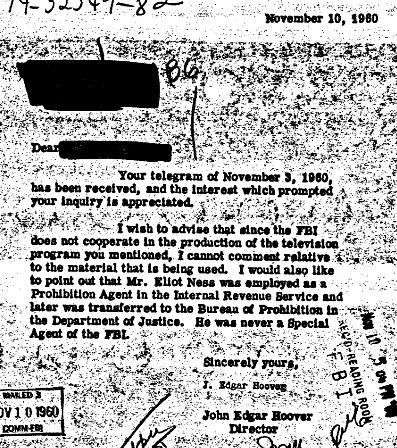
An FBI Standard Reply To Persons Writing In About "The Untouchables" Program and Ness himself.
A more accurate picture of "The Untouchables" and Ness has seemingly unraveled over the last fifty or more years. Many familiar with gangster research opine today that revelations about Ness and his 1957 book with writer Oscar Fraley ("The Untouchables") portray a Prohibition Agent, basically trading his story and information for drinks from Fraley long after his career was over. In fact, many contend there was a lot of heavy drinking during the book's creation and as a result, there are now severe credibility issues. It does seem clear from Paul Heimel's book, below, that both Ness and Fraley were in agreement to embellishing the tales. (In the interest of fairness, I note here that Ness' literary agent later had mentioned he was not a heavy drinker, contrary to what others wrote. I'm not sure if many would agree with that.)
Crime Library.com didn't pay Ness any friendly attributes either noting "The creation of the Ness legend began with Eliot himself. "The Untouchables," the book by Ness and writer Oscar Fraley was for the most part true, but things embarrassing to Ness were left out and the recounting of the war against Capone was hyped and exaggerated. Ness did not think it was necessary to burden his readers with two failed marriages, a number of business failures and his abrupt resignation as Cleveland's safety director after his automobile accident. In fact, he allowed his readers to think that Betty Ness was the only wife he ever had." They continued:
"While these details were not horribly serious in a commercial biography, they nonetheless were the first major written deviation from the facts of his life. Subsequent creative works would go far beyond the fact bending that existed in the Ness autobiography." (My only comment about Crime Library's observation is that their belief that the book was "for the most part, true..." must have come long before author Paul Heimel's research and interviews with some of the original "Untouchables.")
There's no doubt that Ness and his men pursued Capone and others with much vigor and proved they couldn't be bought off. Yet it does appear that much of what Ness did, or did not do, may be lost to history and upon re-evaluation, may not even be close to being accurate.
Other than the famous book about the "Untouchables" the other and most recent writing seems to be done by Paul Heimel, a former neighbor of Ness in Pennsylvania. "Americans love a hero," writes Paul Heimel, author of a new book on Eliot Ness. "They're fascinated by a villain. Stories pitting good against evil captivate them. That could explain their fascination with Eliot Ness."
““...actual “Untouchables” [interviewed] reveal that many of Ness’ stories arent’ even close to what happened.””
So goes the introduction to Heimel's, "Eliot Ness: The Real Story." You'll find out that actually even Fraley, with Ness fully knowing Fraley was doing it, fabricated a lot of what happened. While Ness supposedly despised the "embellishing," he also clearly needed the money to come from the book. To Ness' detriment, Heimel interviews some of the actual "Untouchables" who reveal that many of Ness' stories aren't even close to what happened. In a way, some might argue that Ness did a disservice to other members. Things are bad enough when critics who weren't there question the integrity of the information. But when you have actual eye witnesses - those who were there and actual squad members - refuting the information, the integrity loss is no doubt racheted up.
Heimel's book reveals that after Ness' written exaggerated, and even fictitious days with "The Untouchables," nothing in Ness' life went well. Not his efforts with the Cleveland "Torso" case, not his business ventures nor his political efforts, surely not his financial situation, and finally, his health. When he died, he left only a few hundred dollars to his wife and adopted son.
Long into the 1950s, (and even to this day with many) the public still had Ness associated with the FBI. Not so as as you can see by this late '50's memo. Obviously Hoover didn't want this and neither did the sons, daughters and grandchildren of the men who were really present at historical incidents. Hoover's comment is at the bottom of this memo shown below.
The memo you see here reveals Hoover cautioning a friend regarding Ness.

It's worth mentioning today in 2014, the soon to come Law Enforcement Museum obtained memorabilia about Ness and the "Untouchables" from his secretary. These items will be on display at the museum in 2015. Check this link for more:
http://www.nleomf.org/newsroom/news-releases/museum/national-law-enforcement-16.html
If there were ever symbols in law enforcement of honesty and integrity, there's no doubt that Ness and some of his men filled those requirements in the early beginnings of the squad. Unfortunately, as years went on, there's a dense fog that surrounds the rest... ...