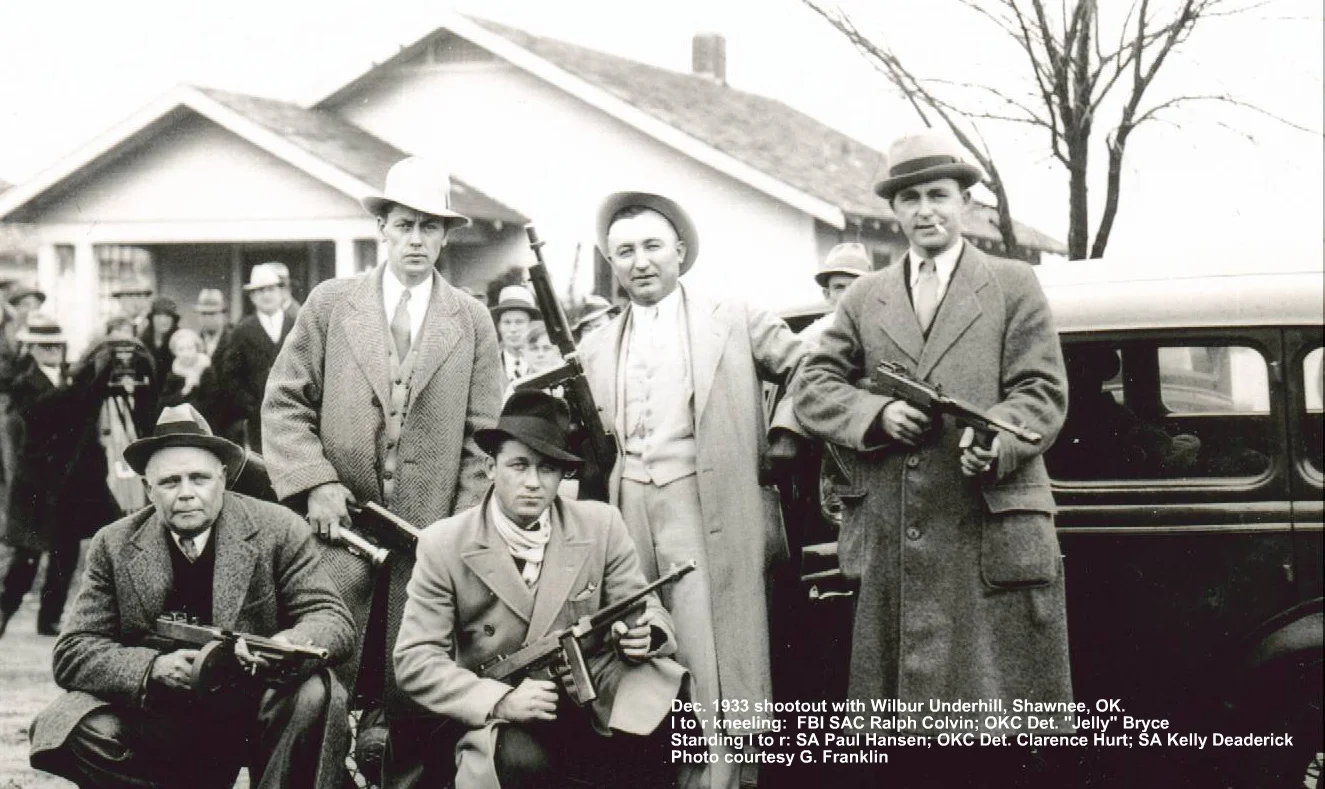
For The Honor Of Their Fathers...
".... you don't know what hell is until you are a young housewife in Chicago with a 3-month old child and your husband gets a call to throw some clothes in a bag and go to Wisconsin at once. Later that evening a radio bulletin said that 2 unidentified FBI agents had been killed in Wisconsin. The wife of the agent across the hall and I called the Bureau headquarters all night trying frantically to find out if we were widows.......When you have gone through that you will have been through hell." (Judge Don Metcalfe, son of Special Agent (SA) James Metcalfe, recalls his mother's words.)
The Depression Era's war on crime came on hard, and it came on fast. To say that formal firearms and investigative training was still in its infancy is an understatement. As Judge Don Metcalfe told me in a telephone interview, "It wasn't until months after the Kansas City Massacre in 1933 that my father had to learn how to shoot a gun and drive a car."
The 1920s claimed the lives of two FBI agents. Between 1933 and 1934 alone, four FBI agents would be dead, and others wounded by the wretched bastards they pursued. By decade's end, four more agents would be added to the list of those lost. Policemen, sheriffs and detectives who worked with or without the Bureau were no less vulnerable.
Bureau agents and others who fought the 1930's war on crime didn't understand how much all of it would tax their home lives. Their remarkable bravery overshadowed the haunted thoughts that they may make widows of their wives and leave their children fatherless. What records of both theirs and official that can be found reveal the enduring and relentless fatigue of extremely long hours; of being in one city one day and another the next. The all night driving or the seemingly limitless Pullman train rides. Boring and endless stakeouts; false leads and mistaken identities. At times, on the move with only the clothing on their backs. Only to bed down in some motel or private room in a remote corner of a dusty, dry America or a grimy industrial city. There would be days and weeks away from their wives, their children and their friends who would have no idea of where they were or what they were doing. For many, the chase offered the best meal it could; a hardened sandwich and a cup or two of some diner's rancid coffee. For many, Christmas and the important yearly holidays would have to wait another year…
Former Chicago FBI SAC, Melvin Purvis wrote about his FBI career in "American Agent" in 1935 after he resigned from the Bureau. He casually mentioned "my travel bag consisted of my hat." In the examination of documents left behind in personal and FBI files, we can readily see how brutal life’s demands were on the limited Bureau staff nationwide.
“They belonged to the glory company of history...”
Importantly though, Purvis wrote "There were men who served with me who never knew the emotion of fear. They belonged to the glory company of history, those joyous daredevils who, from time immemorial, have been vainly waiting for a commander to order a charge on the gateways of hell....for it was war, and nothing less....but the story of what went on behind the scenes...made possible the triumph of law and order, has never been told." Tireless investigations, heartbreaking and tragic failures, Purvis recalled. "....What we really needed was one night of uninterrupted sleep...."
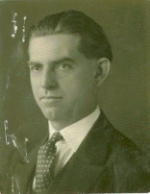
1925 - Charles B. Winstead - (FBI Application Photo)
One small article I read years back was the catalyst for the creation of this website.
An online Dallas newspaper report revealed that the memoirs of former FBI Special Agent, Charles Winstead were in a museum in Sherman, Texas. Having known the Winstead name and his role in the Dillinger shooting and many other high profile cases of the '30s, one could only wonder why a document of this value to FBI and police history had never made it out of the city of Sherman where Winstead was born. Or at least copies of it. It was important that others read it. After all, Winstead was just one of the many who belonged to the "glory company of history" that Purvis referred to.
But somehow overpowering the news story of John Dillinger and the Winstead memoirs, came a final note from the author of the Dallas article. He said, "FBI Agent Winstead, who died in bed at 82 in 1973, is today widely disremembered."
"Winstead is....widely disremembered...?" It's one of those phrases you need to read twice. Let that thought sink in for a moment...
History and the passage of Time does that to us. Memories, like photos, tend to fade as the years march on. In many instances, we know more about the gangsters and cop killers (like Bonnie and Clyde) than we do about those in pursuit. But how many others, especially those who died in the line of duty, are "disremembered?" Men who were such an intricate part of the beginnings of a very young and inexperienced FBI.
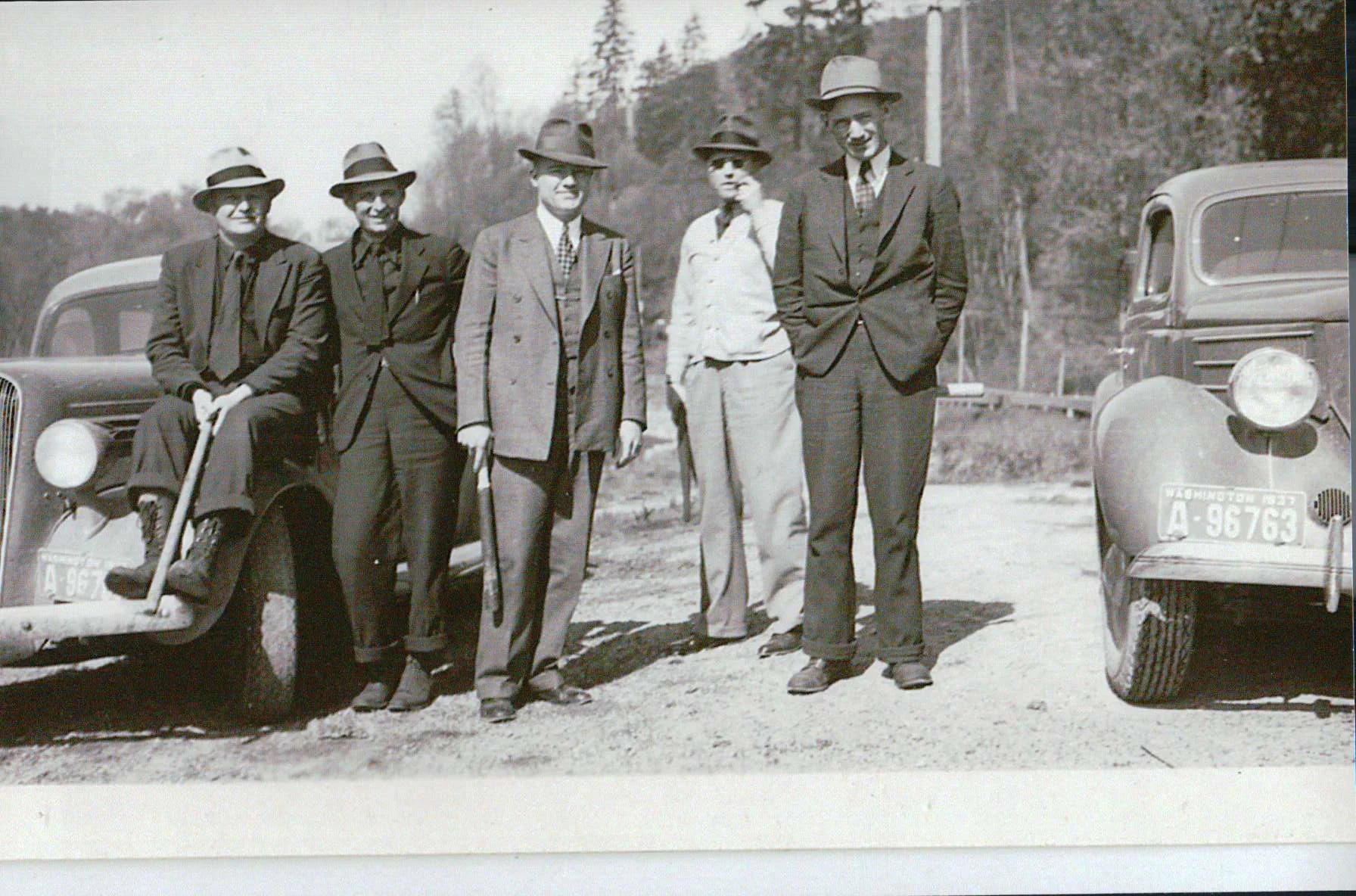
FBI Agents searching the Northwest forests for a kidnapped child. (Courtesy Franklin family)
Who were these young warriors who took on a mission that would cost some their lives and the lives of local officers they worked with? What about those who worked behind the scenes to bring the FBI into the twenty first century? Where did they come from and what was their involvement; what of their own stories about what happened? Where are their children and grandchildren? What of their father's and grandfather's letters, diaries and the now fading photographs no one has seen?
An entire generation of FBI Agents is gone. So is the evil they pursued. Their biographies are diverse. From immigrants to those U.S. born; from lawyers to accountants, former Texas Rangers, or Oklahoma and surrounding lawmen; sports legends, boxers, and veterans of the Great War. Scientists, technicians and others...
For decades, these G-men and their police and detective counterparts have been long forgotten and hardly mentioned except at times to play second fiddle to our own obsessions with the killers they pursued. Today, not many will know the names of the men who left their homes and families in pursuit of those who wreaked havoc on the weak and defenseless of American society. Under perhaps the worst of conditions, FBI men and local law enforcement counterparts at times who risked their lives daily and who were the real heroes of America's "lawless years." An era of straw hats, tommy guns, dusty midwest roads, wooden shacks, rented rooms, and running boards.
FBI Agent James J. Metcalfe of the 30s left us with their vision when he wrote "Portraits; We Were The G-Men." "We helped the Bureau grow, we suffered heartaches and we lost the lives of several men. But surely everyone of us would do that job again. Because today the FBI is worthy of its name and we are proud and happy that we helped create its fame."
This website is a tribute to the many FBI Agents of the '30s now long "disremembered," their police counterparts and a very young FBI they were so proud of. It is now their official recorded accounts in file of what happened - sometimes distorted by many over the decades. It's these records, their photos left behind; their letters, diaries, their memoirs, family recollections which tell us the stories of those forgotten...
.........For their survivors, this site is for the honor of their fathers and grandfathers...
Copyright, Larry E. Wack. Photos and content of this website cannot be used without permission. Contact us through the Navigation Section above.
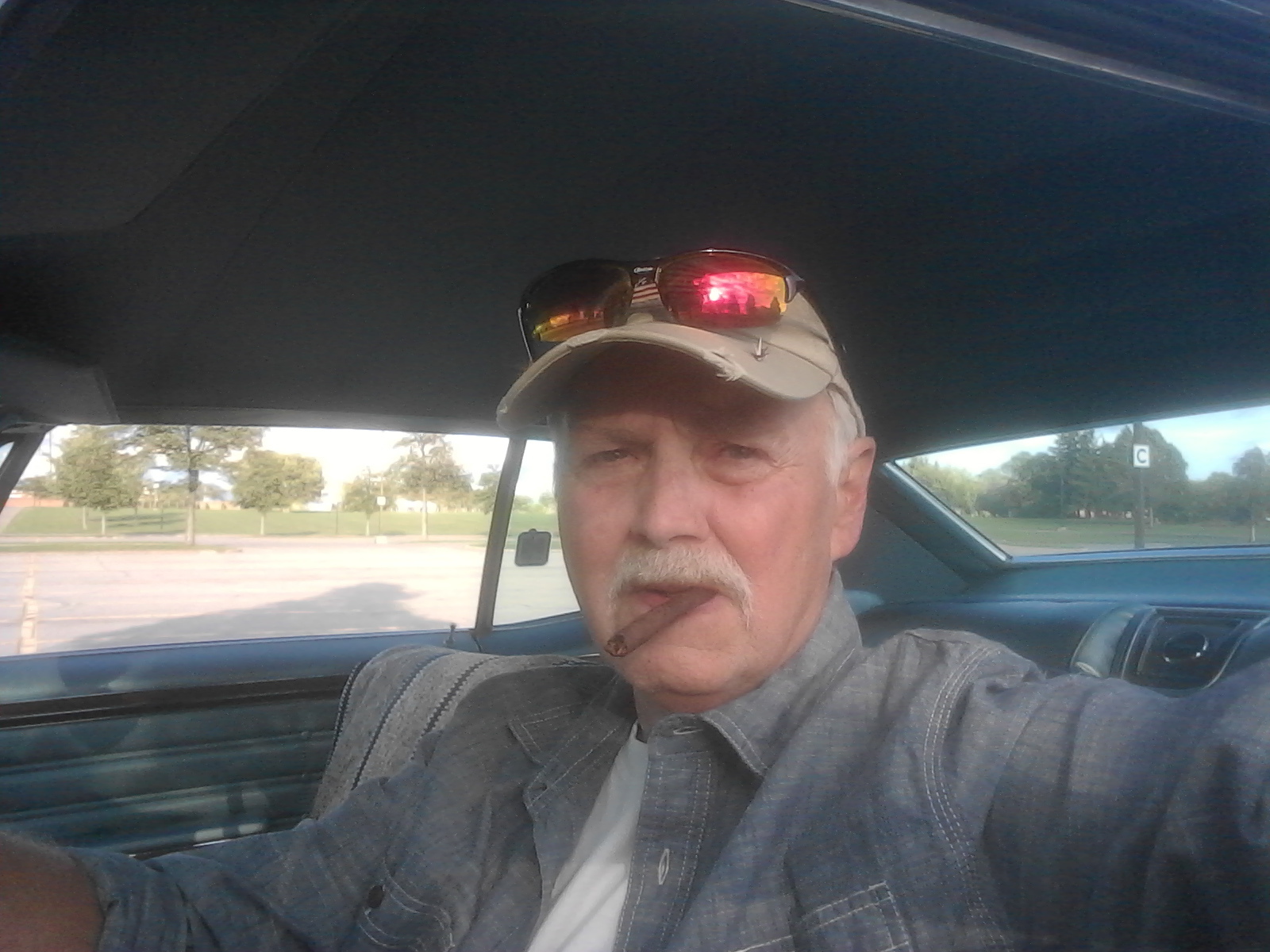
Retired Special Agent, Larry Wack@2015
Larry Wack passed away on January 14, 2019, after a long battle with cancer. This website will be kept online for the foreseeable future by his surviving family in memory of all of the research and dedication that he put into preserving the FBI history. There are no alterations/additions planned at this time.
Website owner/editor, retired FBI Special Agent Larry Wack, spent over 30 years in the FBI. During the years of 1968 to 1972 he worked in Director J. E. Hoover's FBI in Washington, D.C. as a support employee while attending college at night. A majority of those years were spent in the Civil Rights Section of the General Investigative Division. After Director Hoover died in May, 1972, Mr. Wack continued working at FBI Headquarters until 1975. In 1975, being a graduate of American University in Washington, D. C., he became a Special Agent of the FBI. After graduating the FBI Academy, he was assigned to the NYC Office's bombing investigations squad, later becoming a member of the Bureau's original Terrorist Task Force. During that time he was intimately involved in the Bureau's major terrorism cases of the era. After only a few years out of the Academy, he was the recipient of the Attorney General's Award For Excellence In Law Enforcement. In 1990, he was transferred to the Buffalo, N.Y. Office. There he assisted with the original set-up and became the Coordinator of the Fugitive/Gang Task Force, in addition to having his own caseload. He retired from the FBI in 2003.
Until recently, he spent a lot of time with hobbies of fly fishing and his 1966 Chevy "muscle car. '“ Going to Cruise Nites" and re-visiting those wonderful days of music by Buddy Holly and others of that era.
Comments and opinions of the site owner do not necessarily reflect those of other current /former or retired Special Agents nor other law enforcement entities. The site editor/owner is not a spokesman for the FBI or any related Societies.